FoodieAtlas
Recipes around the World
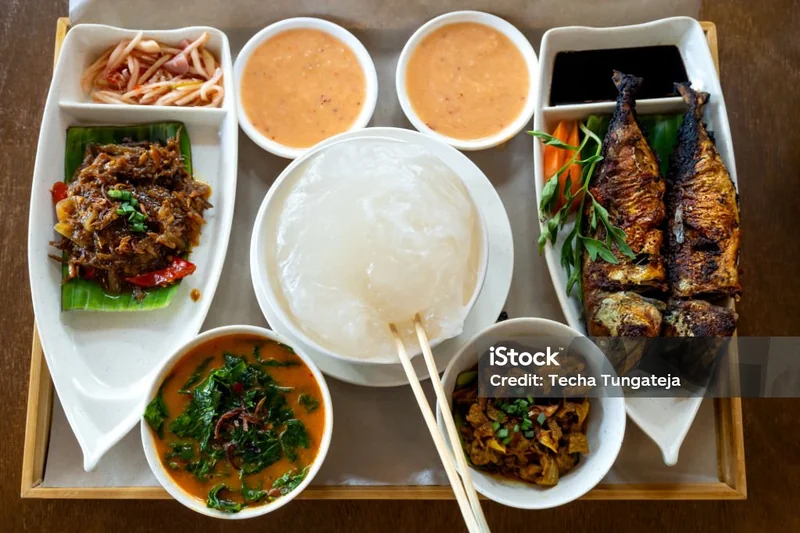
Ambuyat is Brunei's national dish, and one of the most unusual foods in Southeast Asia. Sago starch, taken from the pith of the sago palm, is whisked with boiling water until it turns into a clear, glue-like mass. It is eaten by twirling it around a pair of bamboo sticks called candas, dipping it in a sour and spicy sauce, and swallowing it without chewing.
On its own ambuyat tastes of very little. What makes it is the cacah sauce and the dishes around it, usually fried fish, vegetables and sambal, shared from the middle of the table. The ambuyat itself takes only a few minutes to make once the water is boiling.
Pound the chilies, shallots and toasted belacan into a rough paste with a mortar and pestle. Stir in the strained tamarind water, lime juice, sugar and a pinch of salt. Taste: it should be sour, salty and spicy all at once. Set aside so it is ready before the ambuyat is made.
Have your side dishes cooked and on the table first, such as fried or grilled fish, stir-fried vegetables or sambal. Ambuyat firms up as it cools, so it should be eaten the moment it is ready.
Put the sago starch in a large heatproof bowl and stir in the room-temperature water until it becomes a smooth, milky slurry with no dry lumps.
Bring the remaining water to a full rolling boil. Pour it into the slurry in a steady stream while stirring fast and continuously with a wooden spoon or chopsticks. Within a minute the white mixture turns into a clear, glossy, glue-like mass. Add boiling water only until it looks fully translucent and stretchy.
If parts of the mixture are still opaque and white, the water was not hot enough. Set the bowl over a pot of simmering water, or heat it briefly in the microwave, and keep stirring until it turns clear.
Bring the bowl to the table immediately. Each person twirls a portion around a pair of candas (two-pronged bamboo sticks) or chopsticks, dips it into the cacah sauce and swallows it without chewing. Eat the side dishes between bites.
Ambuyat is Brunei's national dish: sago starch mixed with boiling water until it becomes a translucent, sticky mass. It has almost no flavor of its own and is eaten as a base for tangy sauces and side dishes, much like rice or bread in other cuisines.
On its own ambuyat tastes very mild, with a slightly starchy flavor. Its appeal is the texture, which is smooth, gluey and slippery, and the sour, spicy dipping sauce (cacah) that coats each bite.
Twirl a portion of ambuyat around candas, a pair of bamboo sticks joined at the top, then dip it in the sauce and swallow it whole without chewing. Chewing makes it stick to the teeth. Regular chopsticks work fine at home.
The classic is cacah binjai, a sour sauce made from binjai fruit. Because binjai is hard to find outside Borneo, tamarind-based cacah with chili, shallots and shrimp paste is a common substitute. Tempoyak (fermented durian) sauce is another traditional choice.
The water was not hot enough. Sago starch only turns clear and stretchy at boiling temperature. Pour water at a full rolling boil, stir quickly, and if white patches remain, warm the bowl over simmering water while stirring.
They are close relatives. Linut from Sarawak in Malaysia and papeda from eastern Indonesia are also made from sago starch and boiling water. Ambuyat is the Bruneian version and is usually served with cacah and a spread of side dishes.