FoodieAtlas
Recipes around the World
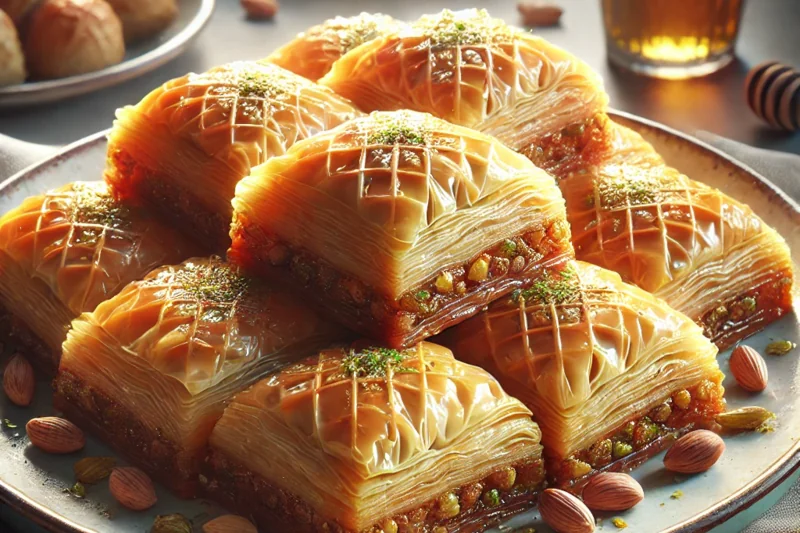
When baklava comes out of the oven, you immediately smell honey and almonds—the phyllo has turned to gold, and the warm syrup pools between the layers, still dripping slightly at the edges. Albanian baklava differs from its Turkish or Greek cousins in its use of honey and lemon for the syrup rather than plain sugar water, and in the addition of cloves to the nut mixture, creating something warmer and less cloying. This pastry came to Albania with the Ottoman centuries but settled into Albanian identity so completely that nearly every town considers its baklava a local specialty, sold by weight from pastry shops and brought out at Christmas and Eid. The critical technique is cutting all the way through before baking, not after—once the syrup sets, you'll shatter the layers trying to cut them.
In a large bowl, combine the chopped walnuts, chopped almonds, ground cinnamon, ground cloves, and 1/4 cup of granulated sugar. Mix well.
Preheat your oven to 350°F (175°C). Grease a 9x13 inch baking dish with some of the melted butter.
Carefully unroll the phyllo dough. Cut the whole stack in half to fit the dish. Cover the dough with a damp cloth to keep it from drying out as you work.
Place two sheets of phyllo dough in the bottom of the baking dish. Brush generously with melted butter. Repeat this process until you have layered 8 sheets of phyllo, each brushed with butter.
Sprinkle a thin layer of the nut mixture (about 3 tablespoons) over the phyllo.
Place two more sheets of phyllo on top of the nuts, brush with butter, and repeat the process, layering nuts and two sheets of phyllo, until you have used all the nut mixture. End with a top layer of 8 sheets of phyllo, each brushed with butter.
Using a sharp knife, cut the baklava into diamond or square shapes, making sure to cut all the way to the bottom of the dish.
Bake in the preheated oven for about 50 minutes, or until the baklava is golden brown and crisp.
While the baklava is baking, combine the water and 1 cup of sugar in a saucepan. Bring to a boil, stirring until the sugar is dissolved.
Add the honey, vanilla extract, and lemon juice. Reduce the heat and let it simmer for about 10 minutes.
Remove the baklava from the oven and immediately pour the hot syrup over it, making sure to cover all the pieces. Let the baklava cool completely in the dish.
Once cooled, carefully lift the pieces out of the dish and arrange on a serving platter.
Baklava is a layered pastry made by alternating paper-thin phyllo dough brushed with butter and studded with layers of chopped walnuts and almonds mixed with cinnamon and cloves. Once baked until golden, the entire pastry is drenched with a hot honey-lemon syrup that soaks into every layer, creating a sweet, sticky, and crispy-yet-tender confection.
Baklava originated in the Ottoman Empire and spread throughout the Balkans, including Albania, where it arrived roughly 500 years ago. In Albania, the dessert took on regional characteristics—particularly the addition of cloves and the use of a honey-lemon syrup instead of plain sugar syrup, making it distinctly Albanian in flavor profile.
The foundation is phyllo dough and butter, with a filling of coarsely chopped walnuts and almonds combined with ground cinnamon, cloves, and a bit of sugar. The syrup is made from water, sugar, honey, and fresh lemon juice, sometimes with a touch of vanilla extract for depth.
Cut all the way through to the bottom of the dish with a sharp knife before baking—this is essential because once the syrup cools and sets, you cannot cut the baklava without shattering the layers. Also, have your syrup hot and ready when the baklava emerges from the oven; pouring hot syrup onto hot pastry allows it to penetrate all the layers evenly.
Baklava is typically served with strong coffee or tea, which cuts through the sweetness beautifully. In Albania, it is also common to serve it with cold water or a cool dairy drink to balance the richness. Some prefer it warm, while others allow it to cool completely so the layers set and the flavors mellow.