FoodieAtlas
Recipes around the World
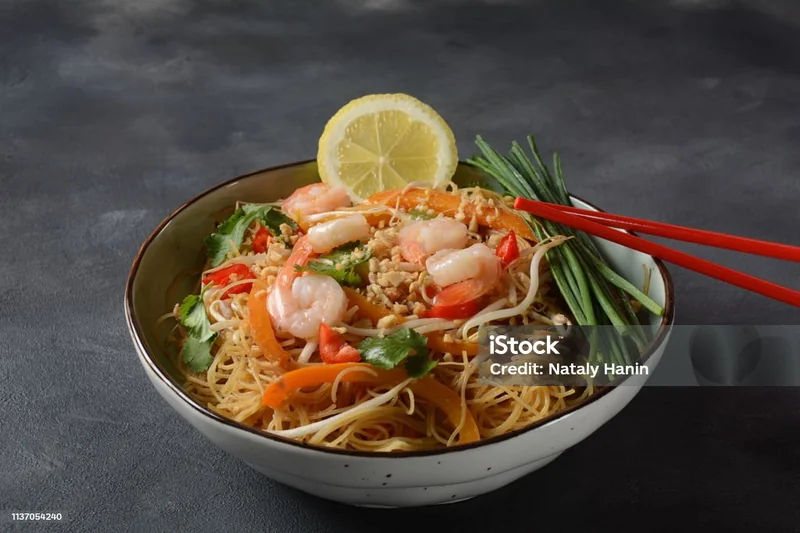
The story of Pad Thai begins unexpectedly: in the 1940s, Prime Minister Phibunsongkhram promoted rice noodles to reduce wheat imports and build national identity — a national dish was essentially created by government policy, and it went on to conquer the world. In Bangkok's night markets, a wok master works fast: thin rice noodles soaked in tamarind sauce, egg, shrimp or chicken, bean sprouts, green onions, crushed peanuts — everything merges in minutes over high heat, the smoky breath called "wok hei" pressing into the noodles. But what defines Pad Thai comes last: the four-condiment tray on the table — fish sauce, sugar, dried chili, crushed peanuts — where each person builds their own balance.
Soak the rice noodles in warm water for about 20-30 minutes until they are softened. Drain and set aside.
In a small bowl, combine the fish sauce, tamarind paste, brown sugar, soy sauce, and chili flakes (if using). Mix well and set aside.
Heat 1 tablespoon of vegetable oil in a large skillet or wok over medium-high heat.
Add the shrimp, chicken, or tofu and cook until fully cooked. Remove from the skillet and set aside.
In the same skillet, add the remaining tablespoon of vegetable oil.
Add the minced garlic and stir-fry for about 1 minute until fragrant.
Push the garlic to one side of the skillet and pour the beaten eggs into the other side.
Scramble the eggs until they are fully cooked.
Add the soaked rice noodles to the skillet.
Pour the prepared sauce over the noodles and toss to coat evenly.
Stir in the bean sprouts, shredded carrots, and cooked protein.
Cook for another 2-3 minutes until everything is heated through and well combined.
Transfer the Pad Thai to serving plates.
Top with chopped green onions and peanuts.
Garnish with fresh cilantro and lime wedges on the side.
Pad Thai is a stir-fried rice noodle dish cooked in a wok over high heat with egg, bean sprouts, garlic, and protein — shrimp, chicken, or tofu — bound together with a tamarind-fish sauce-sugar mixture. The hallmark is the condiment tray served alongside: fish sauce, sugar, dried chili flakes, and crushed peanuts that each diner uses to season to their own taste.
Pad Thai was promoted as a national dish by Thai Prime Minister Plaek Phibunsongkhram in the late 1930s and 1940s, partly to reduce rice consumption and partly to build national identity. The campaign popularized a Chinese-influenced stir-fried noodle style with a tamarind-based sauce, which spread from street carts across the country and eventually the world.
Thin flat rice noodles (sen lek) soaked until pliable, tamarind paste, fish sauce, palm sugar or brown sugar, eggs, garlic, bean sprouts, green onions, and crushed roasted peanuts. The sauce should be tamarind-forward — authentic Pad Thai does not use ketchup, a Western shortcut that produces a sweeter, flatter flavor.
High heat and small batches. A home burner will never match a street cart's flame, but you can compensate by not overcrowding the wok — too much food drops the temperature and steams the noodles instead of frying them. Add the sauce directly to the noodles early so it absorbs and caramelizes slightly rather than pooling at the bottom.
Pad Thai is self-contained, but the condiment tray is not optional — it is part of the dish. Set out fish sauce, sugar, dried chili flakes, and crushed peanuts in small bowls. A wedge of fresh lime squeezed over the top just before eating brightens the whole plate. Tom yum soup or a simple cucumber salad makes a natural companion.
/som-tum-(spicy-green-papaya-salad).webp)
/tom-kha-gai-(chicken-in-coconut-soup).webp)
/tom-yum-goong-(spicy-shrimp-soup).webp)