FoodieAtlas
Recipes around the World
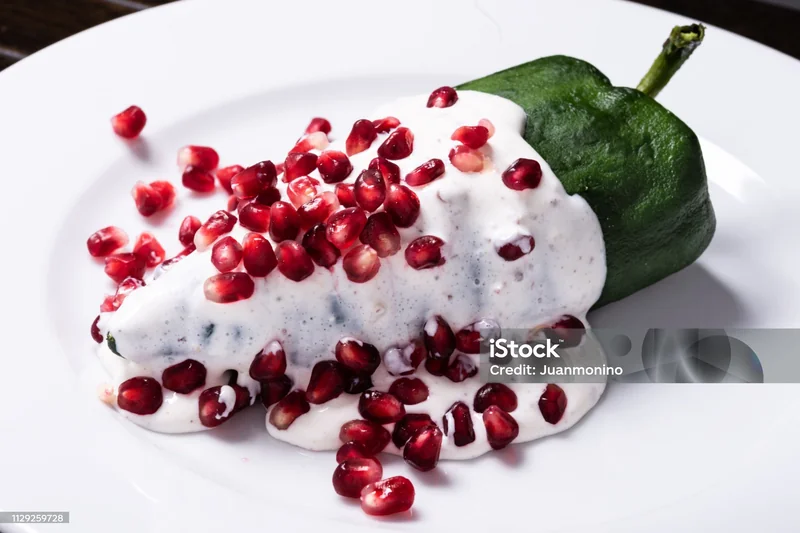
Chiles en Nogada is a dish built around a calendar: it appears in September when pomegranates ripen and fresh walnuts are harvested in Puebla, and it is tied to Mexican Independence celebrations since its origin in August 1821, when Augustinian nuns in Puebla created it to honor the newly signed Plan of Iguala. A large poblano chili (charred and peeled) is stuffed with picadillo — ground pork, dried fruits, spices, almonds — then draped in a cold nogada sauce of fresh walnuts blended with cream cheese and sherry, and finished with pomegranate arils and fresh parsley to display the red, white, and green of the Mexican flag. The dish is never served hot; the nogada must be cold against the warm stuffed pepper. Seasonality is strict: fresh (not dried) walnuts make the sauce creamy and mild; dried walnuts make it bitter.
Preheat your oven to 400°F (200°C).
Place the poblano peppers on a baking sheet and roast them in the oven for about 20 minutes, turning occasionally, until the skins are blistered and charred.
Remove the peppers from the oven and place them in a sealed plastic bag or cover them with a clean towel. Let them steam for about 10 minutes.
Peel off the charred skins, cut a slit down the side of each pepper, and carefully remove the seeds and membranes. Set aside.
In a large skillet, heat vegetable oil over medium heat.
Add the chopped onion and minced garlic, and cook until the onion is soft and translucent.
Add the ground pork or beef and cook until browned. Drain any excess fat.
Stir in the chopped tomatoes, raisins, chopped almonds, diced apple, pear, and peach.
Season with ground cinnamon, salt, and pepper.
Cook for about 10-15 minutes, stirring occasionally, until the filling is well combined and the flavors have melded together.
Stir in the chopped cilantro and remove from heat.
In a blender, combine the soaked and peeled walnuts, Mexican crema or sour cream, milk, crumbled fresh cheese, sugar, and ground cinnamon.
Blend until smooth and creamy. If the sauce is too thick, add more milk to reach the desired consistency.
Carefully stuff each roasted poblano pepper with the prepared filling.
Place the stuffed peppers on a serving platter.
Pour the nogada sauce generously over the stuffed peppers.
Garnish with pomegranate seeds and chopped fresh parsley.
Stuffed poblano with fruit-meat picadillo in cold walnut cream sauce; pomegranate and parsley finish creates Mexican flag colors.
Puebla, 1821; created by Augustinian nuns for independence celebrations; seasonal dish available only in August-September.
Poblano chili, ground pork, dried fruits (raisin, peach, pear), spices; nogada: fresh walnuts, cream cheese, sherry, cinnamon; pomegranate seeds, parsley.
Use fresh (not dried) walnuts for the nogada — fresh walnuts are pale and mild; dried walnuts turn the sauce bitter and brown; serve the sauce cold over a warm pepper.
White rice with tomato (arroz rojo), black beans; served as a main course in September; dry white wine or light lager.