
FoodieAtlas
Recipes around the World
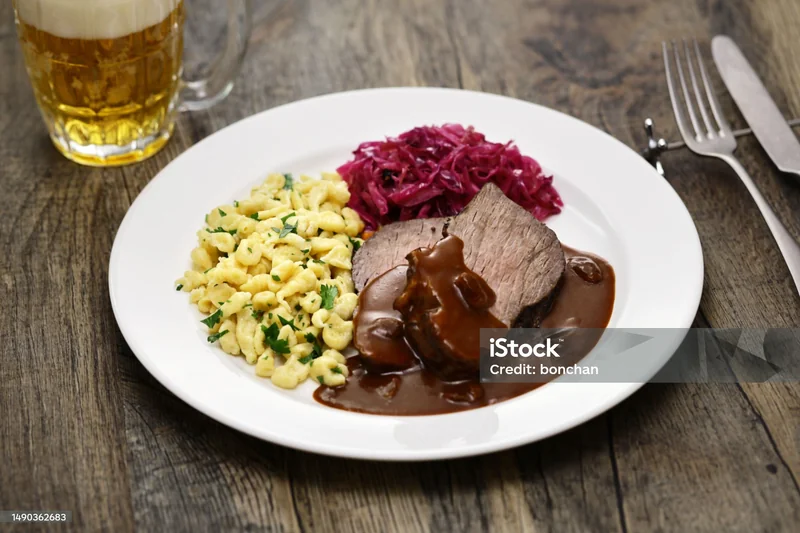
Sauerbraten requires planning before cooking: a large cut of beef (traditionally top round or rump) soaks in a marinade of red wine vinegar, red wine, onion, bay leaves, juniper berries, cloves, and peppercorns for anywhere from two to five days, which both flavors and tenderizes the meat through the action of the acid. What comes out of the marinade is something functionally different from the original cut — more flavorful, with a slight sourness that carries through the entire braise. The sauce is built from the strained marinade liquid, reduced and thickened with crushed Lebkuchen (gingerbread) or raisins in the Rhineland version, which gives it a sweet-sour character unlike any other German sauce. The Rhineland considers this the authentic version; Swabia, Franconia, and Saxony all have their own sauce interpretations.
In a large bowl, combine the red wine, red wine vinegar, chopped onion, minced garlic, bay leaves, peppercorns, cloves, thyme, sugar, and a pinch of salt.
Mix well and refrigerate for at least 24 hours, allowing the flavors to meld.
Place the beef roast in a large resealable plastic bag or covered container. Pour the marinade over the roast.
Seal the bag or container and refrigerate for 3 to 5 days, turning occasionally to ensure even marinating.
Remove the beef from the marinade and pat dry with paper towels. Discard the marinade.
Heat the vegetable oil in a large pot or Dutch oven over medium-high heat.
Brown the beef on all sides until well-seared, about 4-5 minutes per side. Remove the beef and set aside.
In the same pot, add a bit more oil if needed and sauté the remaining chopped onion until softened and golden.
Sprinkle the flour over the onions and stir to combine, cooking for 1-2 minutes.
Gradually add the beef broth, stirring to create a smooth sauce.
Return the beef to the pot along with any juices that have collected. If using, add raisins and crushed gingersnaps.
Bring the sauce to a simmer. Cover the pot and cook the beef for about 2.5 to 3 hours, or until the meat is tender and easily shreds with a fork. Turn the beef occasionally to ensure even cooking.
Remove the beef from the pot and let it rest for a few minutes before slicing.
If desired, thicken the sauce further by simmering it uncovered or by adding more crushed gingersnaps or bread crumbs.
Adjust seasoning with salt and black pepper to taste.
Slice the Sauerbraten and serve with the sauce poured over the top.
Sauerbraten is traditionally served with red cabbage, potato dumplings, or boiled potatoes.
Marinated braised beef. The marinade (2-5 days, red wine vinegar + spices) both seasons and tenderizes the meat. The resulting braise produces a sauce that tastes nothing like other German sauces — it is distinctly sour and complex.
Germany, with distinct regional versions. The Rhineland (Rheinischer Sauerbraten) uses Lebkuchen (gingerbread) to thicken the sauce; Swabia, Franconia, and Saxony each have their own interpretations. Julius Caesar is sometimes mythologized as the inspiration, but no historical evidence exists. The marinating technique is far older — it was practical necessity in pre-refrigeration times.
Beef rump or top round. Marinade: red wine vinegar, red wine, onion, bay leaf, juniper berries, cloves, peppercorns. Sauce: strained marinade + Lebkuchen or raisins (depending on region). The gingerbread/raisins balance the acidity and add sweetness.
Marinate minimum 3 days for the acid to penetrate the meat. Pat the beef dry before searing, or it steams instead of browning — the crust is essential for flavor. The sauce needs the Lebkuchen or raisins to balance the sourness; without it, the dish tastes like sour pot roast, not Sauerbraten.
Kartoffelklöße (potato dumplings), Rotkohl (braised red cabbage), Spätzle. Medium-bodied German red wine (Dornfelder). In Swabia or the Rhineland, this is how Sauerbraten is served — the sides are not optional.