FoodieAtlas
Recipes around the World
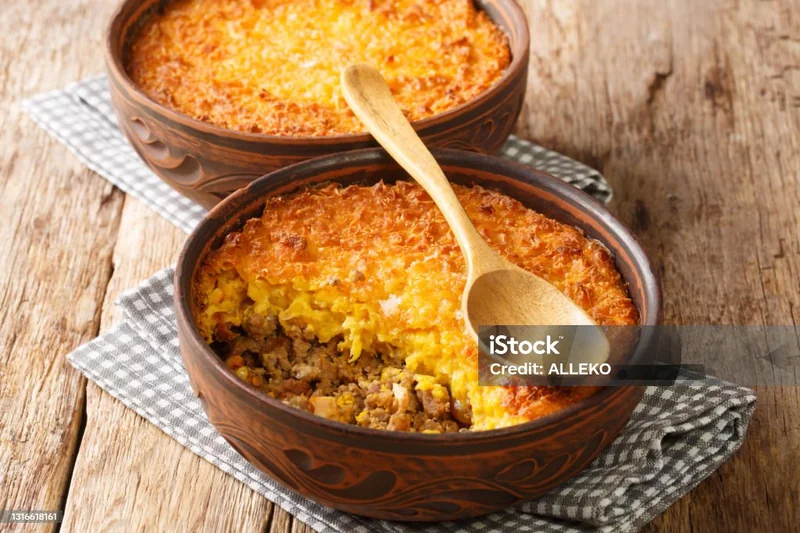
Golden corn paste meets deep-brown meat filling in this baked casserole, where the sweetness of creamed corn corn contrasts with savory pino—a spiced beef mixture studded with black olives and raisins. Pastel de choclo likely emerged during the colonial period, when Spanish settlers' wheat-based pastries merged with indigenous corn into a unified dish. The use of fresh corn (choclo) instead of dried maize marks this as distinctly Chilean rather than Peruvian pastels. Traditionally baked in clay pots that distribute heat unevenly, creating a slightly burnt top layer that adds bitter complexity, this comfort food appears at birthdays, holidays, and informal Sunday gatherings.
Heat olive oil in a large skillet over medium heat.
Add the chopped onion and cook until translucent.
Stir in the minced garlic and cook for another minute.
Add the ground beef and pork, cooking until browned and crumbled.
Mix in paprika, ground cumin, black pepper, and salt.
Stir in the black olives, raisins, and chopped hard-boiled eggs.
Pour in the beef broth and let the mixture simmer for 5-10 minutes, until slightly thickened. Remove from heat.
In a saucepan, cook the corn kernels in a small amount of water until tender. Drain well.
Blend the cooked corn with milk, butter, sugar, salt, and black pepper until smooth. You can use a food processor or blender.
Stir in the grated cheese if using.
Preheat your oven to 375°F (190°C).
In a baking dish, spread the meat filling evenly.
Top with the corn mixture, spreading it out evenly over the filling.
Place the baking dish in the preheated oven and bake for 30-40 minutes, or until the corn topping is golden and slightly crisped.
Allow the Pastel de Choclo to cool slightly before serving.
Pastel de choclo is a Chilean casserole built in layers: pino (spiced ground beef and pork with olives, raisins, and hard-boiled eggs) on the bottom, topped with a smooth, sweetened corn paste baked until the top caramelizes to golden-brown.
This dish emerged in colonial Chile when Spanish cuisine encountered indigenous corn and local ingredients. The emphasis on fresh choclo (large-kernel sweet corn) rather than dried maize is distinctly Chilean, separating it from Peruvian and Argentinian variations.
The pino filling uses ground beef and pork browned with onion and garlic, seasoned with cumin and paprika, then studded with black olives, raisins, and chopped hard-boiled egg. The topping is fresh or frozen corn blended with milk, butter, sugar, and salt until smooth.
Use a ceramic baking dish or clay pot if possible—it heats unevenly and creates the traditional slightly-blackened top. Blend the corn until completely smooth; lumps will prevent an even topping. Let it cool 10 minutes before serving so layers stay intact.
Pair with pebre (a fresh Chilean condiment of tomato, onion, cilantro, and ají verde), or simply with a crisp green salad and perhaps a glass of Chilean white wine.